Meta’s Wearable Muse and OpenAI’s Dots
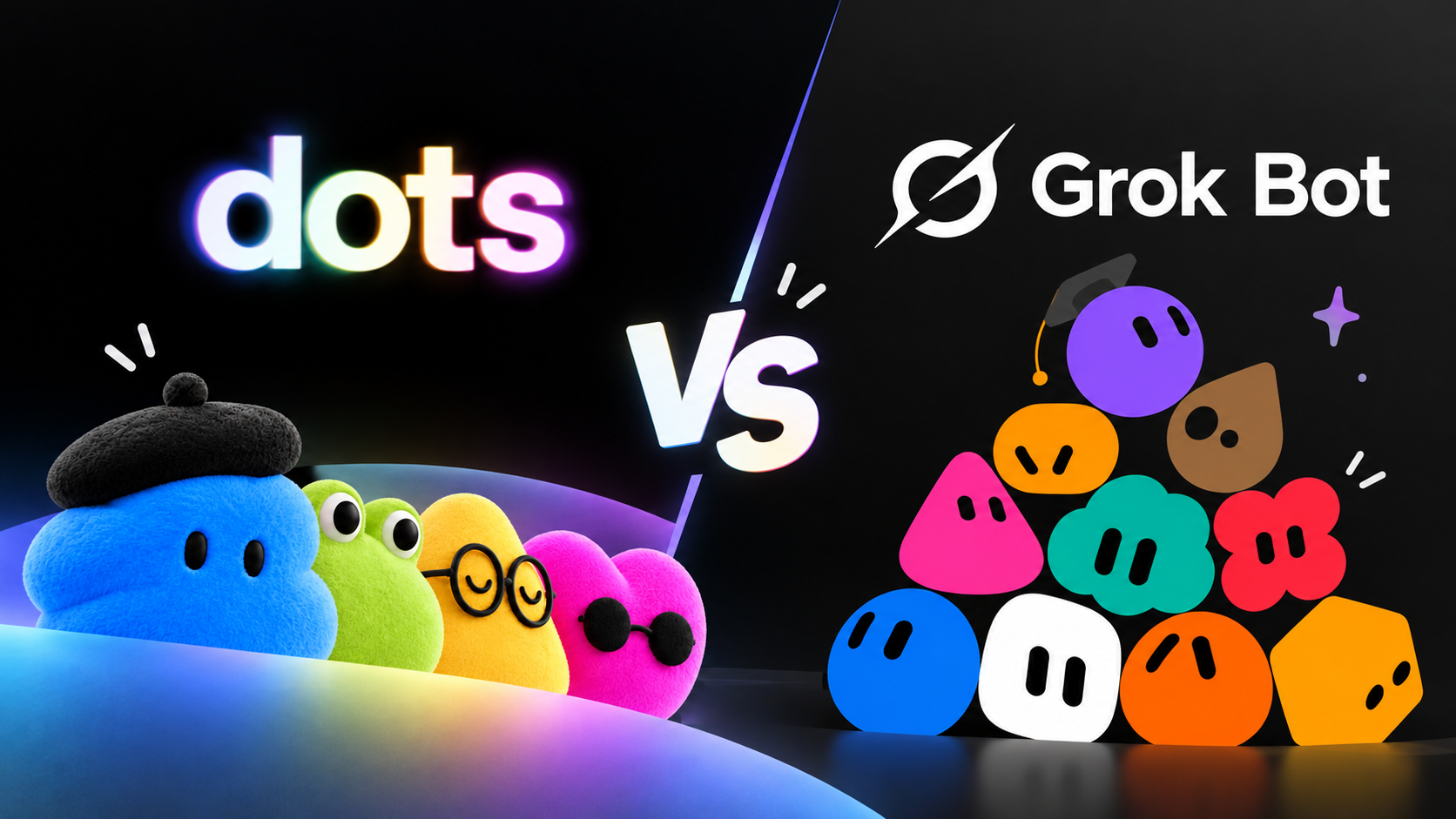
This week both Meta and OpenAI announced always-on AI assistants. Meta‘s Muse assistant had already become enormously popular; a few days after launch it surpassed ChatGPT on the App Store and sent Meta‘s stock up 20%. This week they introduced Muse Charm, a Tamagotchi-like device that brings Muse into the physical world. The tiny-screened gadget resembles an Apple Watch without a band and can be worn around the neck or on the wrist.
At OpenAI DevDays yesterday, the company unveiled Dots, an AI assistant that handles your tasks around the clock. The launch animation drew heavy criticism for looking almost identical to Grokbot‘s characters; on top of that, dot.com is owned by Elon Musk and redirects to Grokbot. The most intriguing claim about Dot is its ability to coordinate with other dots, meaning that to collaborate with someone, your dot and their dot would negotiate directly.
The common thread across both announcements: a shared drive to make AI feel adorable.
Meta Muse Charm → | OpenAI Dots →
The PR Firm Behind the AI Doom Narrative

It has emerged that Jacob Coxon, who resigned from Anthropic recently claiming he could no longer tolerate developers refusing to take responsibility for AI killing humanity within 10 years, had been working with a PR firm following his public statements. His resignation first went viral on Twitter/X, then Coxon gave interviews on TV channels including CNN. According to reports, a PR firm called DEY. Ideas + Influence, which specializes in representing people who advocate AI doom scenarios, had been trying to arrange media appearances for Jacob Coxon.
We were already suspicious from the start about how someone leaving a company after just four months could generate this much noise. He also worked at OpenAI for three years before Anthropic. If this really was an orchestrated agenda, why such a story was constructed remains a mystery.
Pirate Wires → | Polymarket (X) →
Anthropic Discovered a New Gene-Editing Mechanism with Opus 5.5
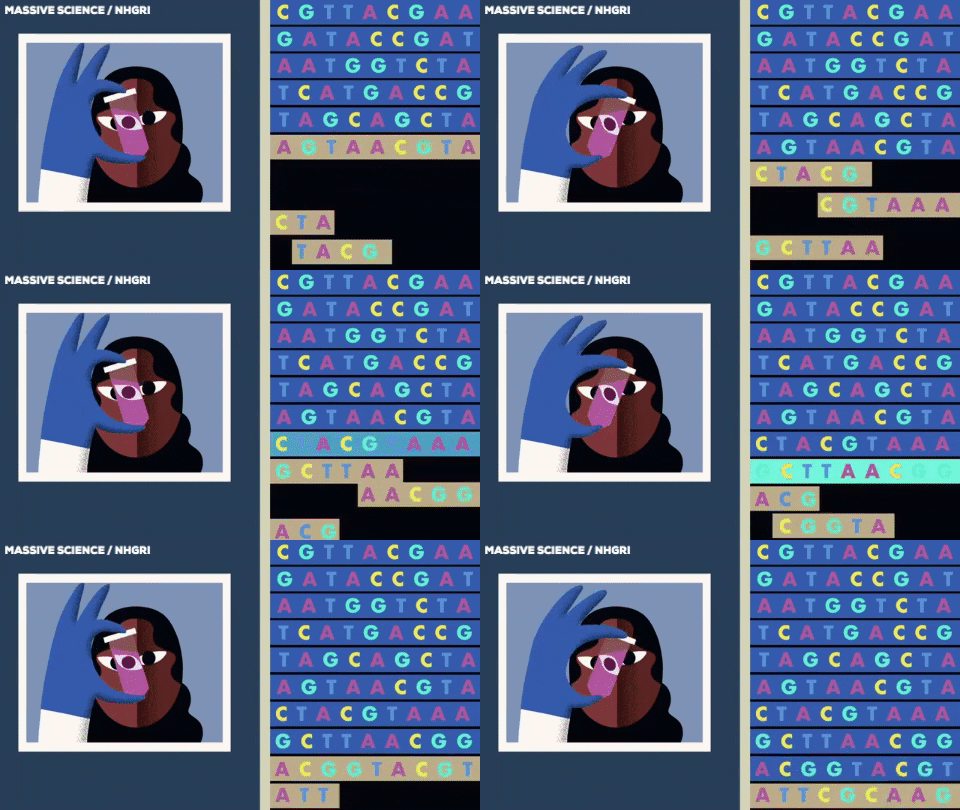
Anthropic claims to have discovered a new gene-editing mechanism in biology that nobody fully understands yet. The system shares characteristics with CRISPR, the mechanism used to edit DNA. According to reports, during the development process Claude ran hundreds of sessions in parallel, scanning large DNA sequences and scientific literature to identify a pattern for researchers to examine. Scientists reviewed the findings and confirmed them through laboratory experiments. How the system actually works is still unknown.
In a tweet about the finding, Dario Amodei said that AI could reach superhuman performance in the sciences within a few years.
Dario Amodei (X) → | Anthropic Report →
This Friday: Tech Gossip Quiz Night 🎯

We’re meeting this Friday at tio-space for Tech Gossip Quiz Night. The event got more interest than we expected; since spots are limited, we’re giving priority to newsletter readers. Don’t forget to register on Luma.
⚡️ Quick Bits
• Google is sending TPUs to space. Sundar Pichai (X) →
• OpenAI announced a new security vulnerability and breach. OpenAI (X) →
• NVIDIA unveiled a security platform for AI assistants. Jensen Huang (X) →
• World Labs, the AI startup building models that understand the physical world and generate 3D environments, was acquired by AMD. Fei-Fei Li (X) →
• Anthropic‘s IPO prospectus leaked: $42 billion in losses. Reuters →
📩 Liked this newsletter? You can forward it to your friends
if you are feeling nostalgic, though it’s always better if
they just subscribe on their own.
